Smart E-Commerce Parking App Business Profit Projections
The global smart parking market was valued at $8.2 billion in 2024 and is projected to reach $22.4 billion by 2032, Smart E-Commerce Parking Business growing at a stunning 13.8% CAGR. This explosive growth is driven by three converging forces:
- E-commerce Explosion: Online shopping reached $6.3 trillion globally in 2024, with same-day delivery becoming standard in urban areas
- Last-Mile Logistics Crisis: Delivery trucks spend 30–40% of their time searching for parking, costing the industry $100+ billion annually
- Urban Space Scarcity: Parking availability is at critical lows in major cities (NYC: 13% available, London: 8% available)
A smart e-commerce parking business solves this exact problem: connecting delivery vehicles with real-time parking availability through an AI-powered app. It’s the missing link between e-commerce demand and urban logistics.
???? What Is a Smart E-Commerce Parking Business?
A smart e-commerce parking business operates a digital platform that:
- Maps available parking spots in real-time using IoT sensors, cameras, or crowdsourced data
- Prioritizes parking zones specifically for delivery vehicles (Amazon, DPD, Fedex, DHL, UPS, local couriers)
- Charges dynamic rates based on location, time, and demand (surge pricing like Uber)
- Integrates with delivery apps to optimize routes and reduce delivery time
- Generates revenue through parking fees, premium subscriptions, and API partnerships
Target customers include:
- ???? Delivery companies (Amazon, UPS, DPD, local couriers)
- ???? E-commerce retailers (seeking faster delivery times)
- ????️ City municipalities (seeking traffic reduction)
- ???? Retailers (needing customer parking solutions)
???? Business Models & Revenue Streams
Choose your revenue model based on startup capital and market focus:
Model 1: B2B Subscription (Recommended for Beginners)
- Charge delivery companies $200–$500/month per vehicle
- Monthly recurring revenue is predictable and scalable
- 100 delivery vehicles = $20,000–$50,000/month
- Startup Cost: $15,000–$40,000
- Profit Margin: 70–80%
Model 2: Dynamic Pay-Per-Use Parking
- Charge $2–$8 per parking session (20–30 min duration)
- Generate revenue from 500+ parking events daily
- Average daily revenue: $3,000–$8,000 in busy zones
- Startup Cost: $40,000–$100,000 (requires more sensors)
- Profit Margin: 60–75%
Model 3: Premium Location-Based Advertising
- Partner with local businesses for targeted in-app ads
- Charge restaurants, shops $500–$2,000/month for premium – 50 partners = $25,000–$100,000/month
- Startup Cost: $10,000–$25,000
- Profit Margin: 80–90%
Model 4: API & Data Licensing (High-Growth)
- Sell parking data to navigation apps (Google Maps, Apple Maps, Waze)
- License real-time parking insights to city planners
- Annual contracts: $50,000–$500,000+
- Startup Cost: $30,000–$80,000
- Profit Margin: 85–95%
Best Strategy: Launch with Model 1 (B2B Subscription) for immediate cash flow, then layer in Models 2–4 as you scale.
???? Technology Stack & Development Costs
Building a smart parking app in 2026 requires these components:
| Component | Technology | Estimated Cost |
|---|---|---|
| Mobile App (iOS + Android) | React Native or Flutter | $8,000–$15,000 |
| Web Dashboard | React.js or Vue.js | $3,000–$7,000 |
| Backend Server | Node.js, Python, or Go | $4,000–$10,000 |
| Real-Time GPS Integration | Google Maps API, GPS tracking | $500–$2,000/month |
| Payment Gateway | Stripe, PayPal, local processors | $500–$1,500 setup |
| IoT Sensor Integration | Camera feeds, parking sensors | $5,000–$20,000 |
| AI/ML Parking Prediction | TensorFlow, custom algorithms | $10,000–$25,000 |
| Cloud Hosting (AWS/GCP) | Scalable infrastructure | $2,000–$5,000/month |
| Customer Support Tools | Zendesk, Intercom | $200–$500/month |
| Total First-Year Cost | $33,700–$85,500 |
Pro Tip: Use no-code/low-code platforms (Bubble, FlutterFlow, Firebase) to launch MVP (Minimum Viable Product) for just $3,000–$8,000 in 4–6 weeks. Upgrade to custom development only after proving market demand.
???? Top 10 SEO Keywords for Ranking in 2026
- “smart parking app for delivery”
- “e-commerce parking business 2026”
- “real-time parking availability app”
- “delivery vehicle parking solution”
- “smart parking technology startup”
- “IoT parking management system”
- “last-mile delivery parking”
- “urban parking app for couriers”
- “how to start parking app business”
- “parking reservation system software”
SEO Strategy: Write 8–10 blog posts (1,500+ words each) targeting these keywords. Optimize title tags, meta descriptions, and include internal links. Expect first-page Google rankings in 3–5 months.
???? Revenue Projections & Income Potential
Year 1: Launch Phase
- Delivery vehicles on platform: 50–100
- Monthly recurring revenue: $10,000–$25,000
- Additional pay-per-use parking: $2,000–$5,000
- Total Annual Revenue: $144,000–$360,000
- Operating Costs: $80,000–$120,000
- Net Profit: $24,000–$180,000
Year 2: Growth Phase
- Delivery vehicles: 200–500
- Monthly recurring revenue: $40,000–$125,000
- Parking sessions daily: 500–1,500
- API licensing contracts: 2–5 cities/partners
- Total Annual Revenue: $600,000–$1,800,000
- Net Profit: $180,000–$900,000
Year 3: Scale Phase
- Delivery vehicles: 1,000+
- Monthly recurring revenue: $100,000–$300,000
- Multi-city expansion: 5–10 cities
- Enterprise partnerships: Tech giants, logistics companies
- Total Annual Revenue: $1,800,000–$5,000,000+
- Net Profit: $900,000–$2,500,000+
???? Marketing Strategy for 2026
Smart parking success depends on aggressive, multi-channel marketing:
Phase 1: Direct B2B Outreach (Month 1–3)
- Contact local delivery companies (Amazon flex, local couriers, DPD, DHL)
- Offer free 30-day trial to 50+ drivers
- Highlight ROI: 30-min parking searches saved 1–2 extra deliveries/day = $30–$60 additional revenue/driver
Phase 2: Content Marketing & SEO (Month 2–6)
- Publish blog posts targeting your 10 keywords
- Create case studies showing “X delivery company cut parking search time by 40%”
- Rank for high-intent keywords organically
Phase 3: Paid Advertising (Month 3–12)
- Google Ads: Target searches like “parking app for deliveries”
- LinkedIn: Target logistics managers, delivery company owners
- Facebook/Instagram: Target business owners, startup founders
- Budget: $2,000–$5,000/month for high-quality leads
Phase 4: Strategic Partnerships (Month 6–12)
- Partner with GPS navigation apps (Waze, Google Maps)
- Integrate with delivery management software (Tookan, Bringg)
- Partner with city municipalities for smart city initiatives
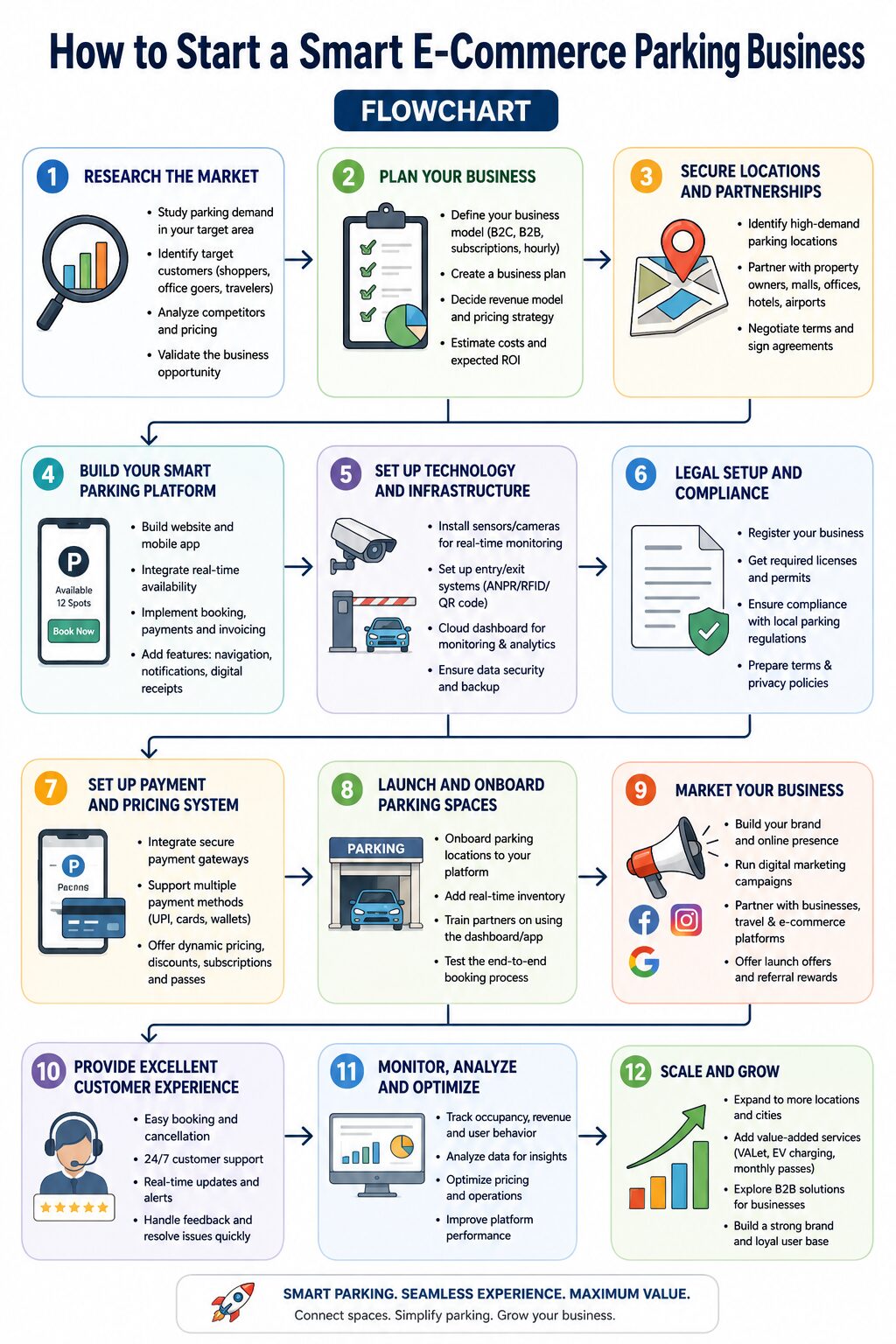
???? Step-by-Step Launch Plan (12 Months)
Months 1–2: Foundation
- Form legal entity (LLC, Corp), get EIN
- Develop MVP using no-code platform
- Build basic website with SEO optimization
- Secure initial $15,000–$20,000 seed funding
Months 3–4: Beta Testing
- Launch beta with 20–30 delivery drivers
- Collect feedback, iterate rapidly
- Publish first 3 SEO blog posts
- Set up Google Ads ($500/month budget)
Months 5–6: Soft Launch
- Expand to 50–100 drivers
- Upgrade to custom mobile app
- Launch LinkedIn and Facebook ads
- Generate first case study
Months 7–9: Growth Acceleration
- Scale to 200+ drivers
- Expand to 2–3 additional cities
- Publish 5–10 more blog posts
- Secure 2–3 API licensing contracts
Months 10–12: Expansion & Scale
- Hit 500+ drivers, $5,000+/month MRR
- Expand to 5–10 cities
- Raise Series A funding ($500K–$2M)
- Pursue enterprise partnerships
⚠️ Key Challenges & Solutions
| Challenge | Solution |
|---|---|
| High initial tech cost | Use no-code MVP first, validate market before investing in custom dev |
| Chicken-and-egg problem (need drivers AND parking spots) | Start with B2B (delivery vehicles) first, they’re easier to convert |
| Regulatory compliance (city permits, data privacy) | Hire local legal consultant ($2,000–$5,000), ensure GDPR/CCPA compliance |
| Competition from established players | Focus on underserved cities (Tier 2–3), offer better pricing/UX |
| Sensor infrastructure costs | Use crowdsourced data + camera feeds instead of expensive IoT sensors |
???? Competitive Advantages in 2026
- Speed to Market: Launch MVP in 4–6 weeks (not 6–12 months)
- AI-Powered Predictions: Use ML to forecast parking availability 30–60 min ahead
- Integration Advantage: Deep API integrations with delivery platforms
- Sustainability Angle: Market as “reduces urban congestion & emissions”
- City Partnership Model: Partner with municipalities for sustainable revenue
✅ Success Checklist
- Validate market demand (survey 50+ delivery drivers)
- Develop MVP with no-code platform
- Secure legal and compliance framework
- Build website optimized for 10 target keywords
- Establish B2B sales process for delivery companies
- Set up paid advertising channels
- Launch beta with real users
- [ Create 5 SEO-optimized blog posts
- Build first case study with real numbers
- Raise seed funding or bootstrapped growth to $50K/month MRR
???? Conclusion
Smart e-commerce parking is a $22.4 billion opportunity in 2026. The market is nascent enough for new entrants to dominate, yet mature enough that demand is proven and urgent. By focusing on B2B delivery vehicle subscriptions, building a solid tech foundation, and executing aggressive SEO and content marketing, you can build a 6–7 figure annual revenue business within 24 months.
E-Commerce Parking Business Delivery Vehicle Parking Solution E-Commerce Parking App Smart Parking Technology 2026 Smart City Parking Revenue Model Smart Parking Business Startup IoT Parking Management System Last-Mile Delivery Parking App Real-Time Parking Availability App How to Start a Parking Business Urban Parking Tech Business Ideas How to Start a Smart Parking Business in 2026